
Since the COVID-19 pandemic suppressed claim experience in 2020, Medicare supplement claims have risen at unprecedented levels. According to a trend analysis completed by Telos Actuarial, the average Medicare supplement claims trend experienced since 2022 is observed to be 11%:
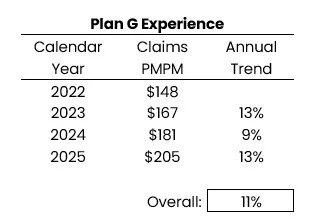
Building off an observed overall trend level, Joan Barrett notes that claims trend has several underlying components (Barret 2020, 602):
Cost
Utilization
Population Shifts
One-time changes
Leveraging
Alternative Payment Methods
Structural Changes
Cost and Utilization are the main drivers of the observed 11% claims trend. These components include medical provider reimbursement rate increases, medical cost shifting, and new medical procedures and technology. In short, as the cost of services increases and more services are utilized, claims trend will be higher year over year.
Underlying population shifts are also relevant to Medicare supplement. As Medicare Advantage carriers close plans in higher-risk areas, more costly claimants may migrate to the Medicare supplement population. As these individuals use a higher number of services, it will put upward pressure on the claims experience leading to higher trend. The increased popularity of “birthday rules” also allows for greater migration than in years past. The values from the closed study above should be protected from these changes impacting the overall market.
With one-time changes, experience can revert to the previous track or result in a new normal. An example of reverting to the previous track would be an event like Hurricane Helene. In this case, it is anticipated that there would be an immediate reduction in utilization, followed by a spike, and then a return to normal. An example of a new normal is that since the COVID-19 pandemic, there has been an increase in outpatient claims, a trend that originated to avoid hospital overcrowding. Alternatively, shifts to telehealth appointments could result in reduced claim severity. Both of these situations would lead to the establishment of a new normal moving forward.
Leveraging of the Part A and B deductibles could also impact Medicare supplement trends. The Part B deductible often increases less than observed trend levels, elevating the trend experienced on Medicare supplement Plan G (which does not cover the Part B deductible.) On the other hand, the Part A deductible (which is covered by Plan G) also increases at a moderate level. It is believed that the leveraging of these cost sharing provisions has an offsetting effect.
Medicare supplement plans have not experienced any major structural changes to benefits or alternative payment methods as of late.